 Mars Pathfinder/Sojourner was launched on December 4, 1996. It arrived on Mars on July 4, 1997 and its mission ended on September 27, 1997. Mars Pathfinder/Sojourner is made of many parts. Pathfinder refers to the rover and the lander together. Sojourner refers only to the rover, which was named after Sojourner Truth and the lander is called Carl Sagan who was an American astronomer, cosmologist, astrophysicist, astrobiologist, author, science popularizer, and science communicator in astronomy and other natural sciences.
The Mars Pathfinder/Sojourner was the first mission developed under the "Low cost rapidly developed planetary mission with highly focused science goals." Under this system Pathfinder/Sojourner was developed in three years for $265 million. It was also the first mission that was completed under NASA's discovery program.
It was originally designed as a technology demonstration as a way to deliver a free ranging robotic rover to the Martian surface. What was created was a mission that succeeded in returning an unprecedented amount of data as well as living twelve times its primary design life.
·
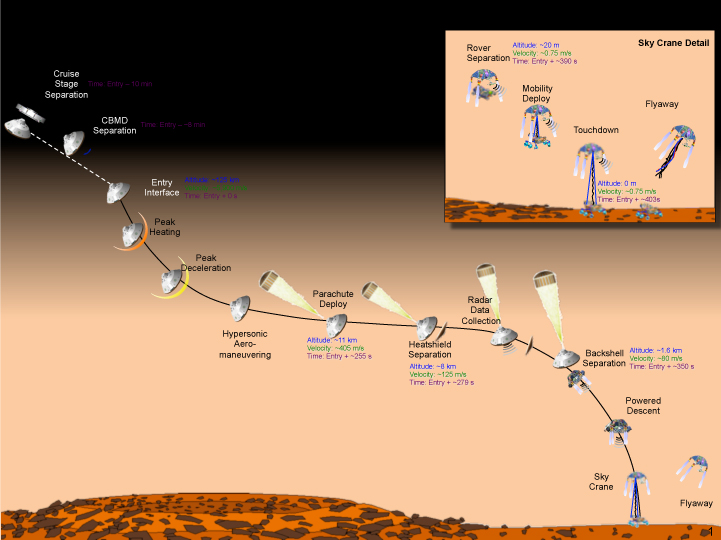
The reason the Pathfinder and Sojourner rover was so successful was because of the innovative way it entered the atmosphere. A parachute
slowed its decent and for the first time ever a system of air bags cushioned
the impact (see diagram below). The cushioned landing left all systems in tacked which allowed for its science goals to be accomplished and exceeded. Pathfinder landed in Ares Vallis- ancient flood plan in the
northern hemisphere. This area is a very rocky surface on Mars but it was safe to land in and contained a wide
variety of rock samples.
·
Sojourner was very successful in data collection, technology
pioneering and proving rover missions are feasible.Pathfinder/Sojourner paved the way for future rover missions to continue to study the red planet.
·
·
Sources: NASA
https://en.wikipedia.org/wiki/Carl_Sagan

No comments:
Post a Comment